
A Quantum Connection: CERN Finds New Evidence of Entanglement
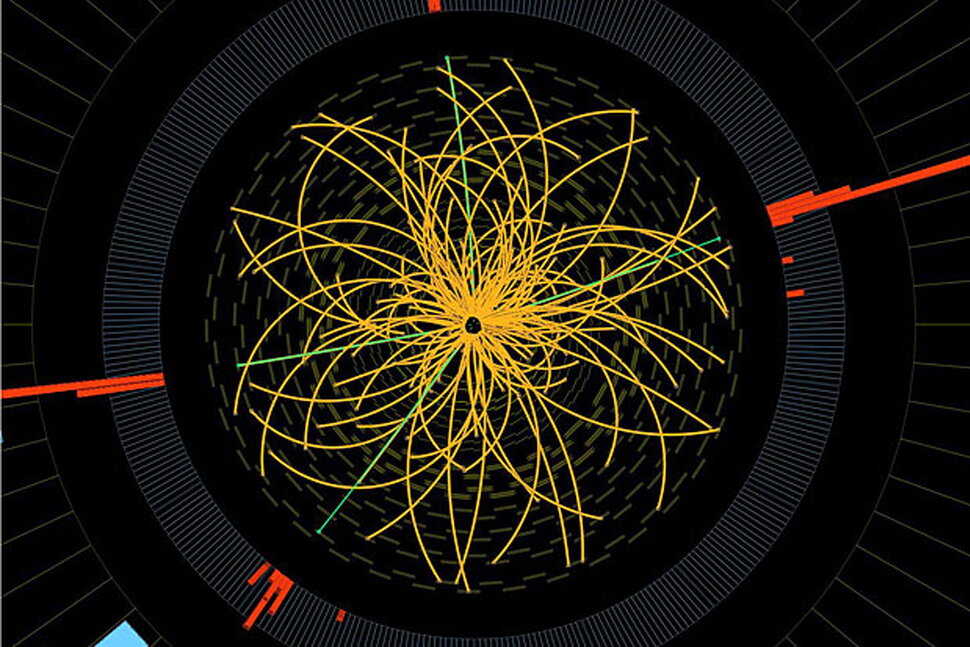
September 26, 2026Particles don’t have to stick around for long to reveal something fascinating. On September 17, 2026, CERN reported that researchers from its ATLAS and CMS experiments had found strong evidence of quantum entanglement between pairs of Z bosons produced when a Higgs boson decays. The finding opens another way to explore quantum physics at the Large Hadron Collider.
Entanglement means that two particles share a quantum state rather than behaving as completely independent objects. In this study, scientists investigated the particles’ spin—a quantum property loosely comparable to angular momentum. Z bosons have three possible spin states, making their quantum relationships more complex than those of particles with only two.
But there was a challenge: Z bosons decay almost immediately. Instead of detecting them directly, researchers measured the electrons and muons left behind. Those measurements let the teams reconstruct the Z bosons’ spin properties and look for statistical evidence of entanglement. Both experiments found strong evidence of the effect using data from the collider’s second and third runs.
What makes this exciting is not that entanglement itself is new, but that scientists are finding new ways to investigate it. By using Higgs boson decays as a testing ground, researchers can explore quantum connections in short-lived particles at high energies—turning fleeting events into a clearer picture of how nature works.